A personal focus platform
There's something you've been meaning to do.
It's still not done. And it isn't because you forgot.
Pick the two blanks above. The rest of this page will start speaking to you instead of at you.
The task is not the end. It is a means to the end. If the end is not visualised, and given meaningful value, there is no true reason to perform it.
Everyone, at every age
You didn't forget. You couldn't start.
That's as true for a fourteen-year-old with an essay as it is for a chief executive with a board pack. Same failure, wildly different stakes. Tell us which one you are and we'll stop speaking in general terms.
Same failure, different stakes
The history essay Saturday, free The board pack R 150 000 a year The medical check Shifted 4 timesThe evaluation scores your tasks, never you, and runs entirely on your device. In the app, task and diary content is encrypted on your device before it goes anywhere.
See it work
Five moments, and you have the whole argument.
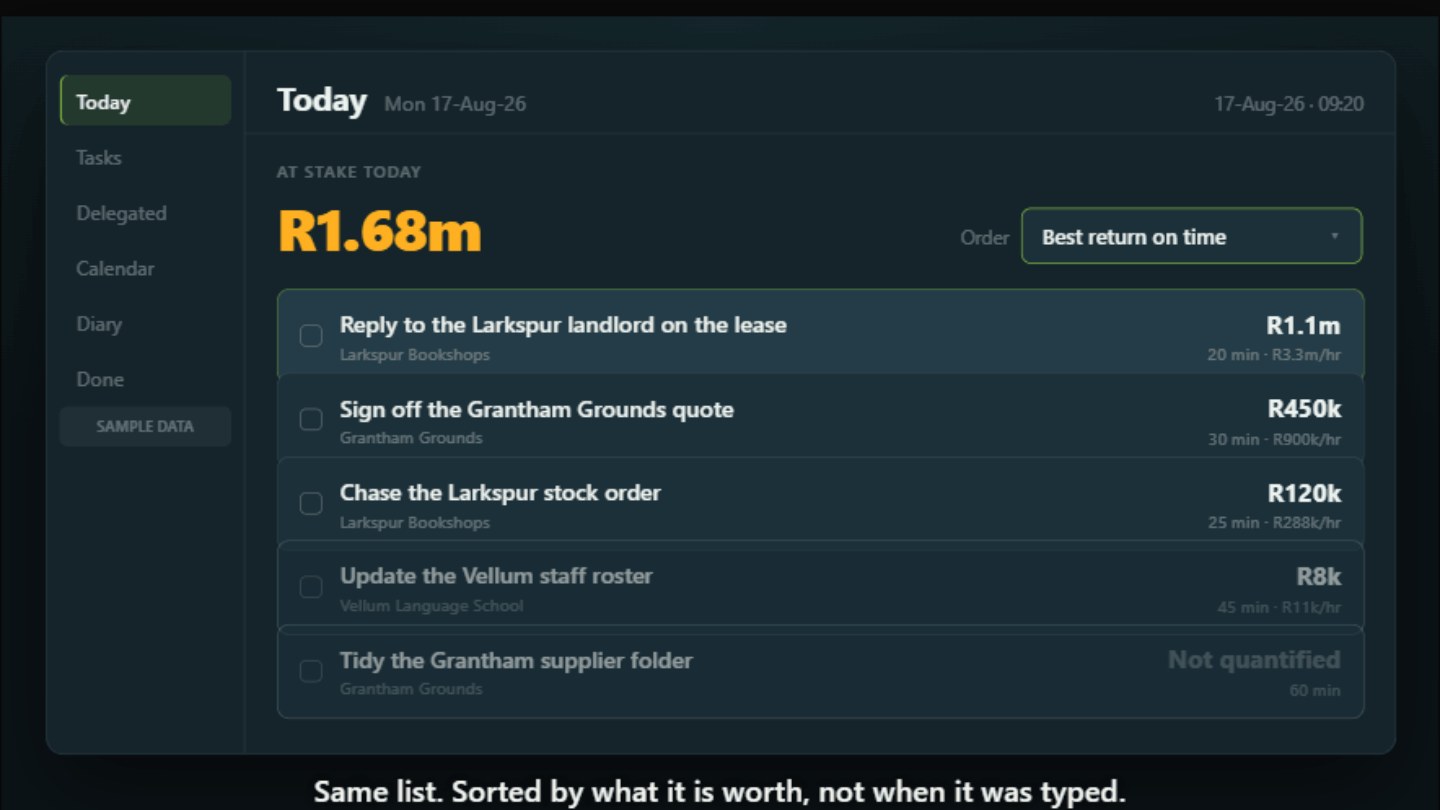
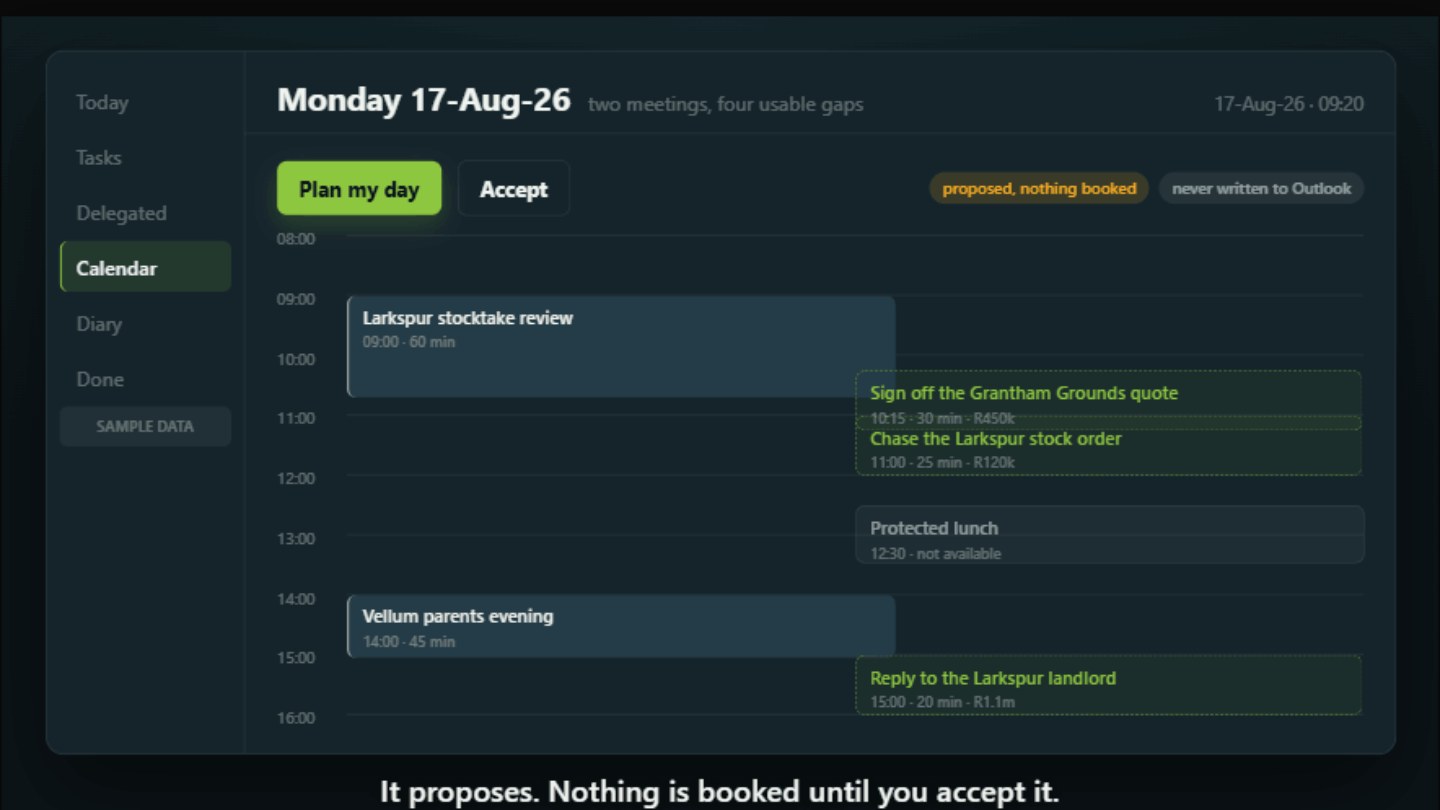
Taken from the live demo, so every figure and company on screen is invented. Still frames for now: the short clips are being recorded and land here shortly.
Didn't see yourself up there?
Then pick the line that stings.
Same product underneath. We'll just stop talking about it in general terms.
Get it out of your head
Seconds to enter, with just enough structure to be useful later. How long it'll take, and what it's worth.
Write down what you get
In your own words, with a number on it. That's the bit every other tool leaves blank, and it's the bit that makes you start.
Nothing gets deleted
No streak held hostage, no red badge shouting at you. A bad week is a bad week, and the record of what you finished keeps growing.
Said out loud, every day, everywhere
What's actually different
Most apps ask what's urgent. We ask what it's worth.
FocusMe ranks what you have to do by the Eisenhower Matrix and by what it's worth in Rands, pulls your Outlook meetings in beside it, and tells you what your day can actually hold.
Every task carries a Rand figure or an explicit "cannot be quantified". Nothing is captured without one. That single decision drives everything else: tasks sort by money at stake rather than by when they were typed, and slippage is priced rather than counted.
Which of the two forces is at play?
A benefit to be gained, or a loss to be avoided. They feel nothing alike and they don't deserve the same slot in your day, so the app makes you say which. The dashboard then reports value delivered and value protected as two separate figures.
R5,000 that takes a day loses to R2,000 that takes twenty minutes
Where a task has both a value and a duration, FocusMe shows value per hour. It's the figure that decides what to do next, and it's arithmetic you can check rather than a judgement you have to trust.
"Carried 4 days" instead of a red badge
A task past its deadline says how long it has been carried, and the dashboard reports what slippage is holding, split into value not yet gained and value not yet protected. Framed as exposure, not blame.
Auto-schedule · new in v1.20.0
It proposes. You accept. Nothing moves on its own.
FocusMe looks at the gaps between your Outlook meetings and offers to fill them with work. A plan is computed, shown on screen, and nothing happens until you press Accept.
The complaint in every review of the tools that rebuild your calendar is the same: what you committed to at 10:00 has moved by lunchtime. This is the opposite of that, deliberately. The proposal is a proposal until you say otherwise, and it is never written back to Outlook.
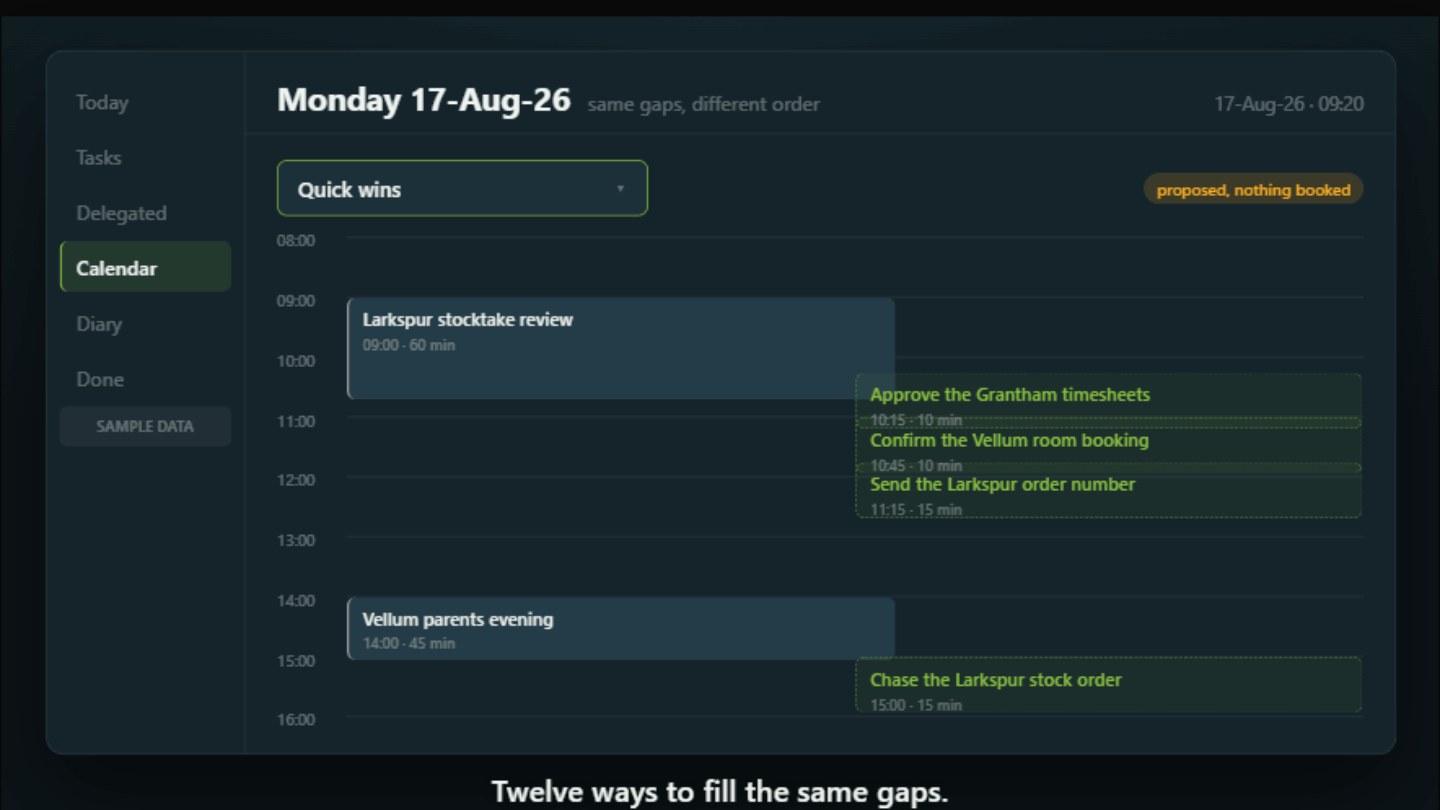
Twelve orders, and you can change it for one day without changing your default
What it refuses to do
Tasks are placed whole
A 25 minute gap gets a task of 25 minutes or less, never the first 25 minutes of a three hour job. Splitting is available and off by default.
Gaps are not just empty time
A buffer either side of every meeting, a protected lunch, a minimum gap worth using, and the clock. Planning at 14:00 does not offer you the morning back.
Delegated work is left out
Its estimate is the other person’s effort, not yours, so it appears in one order only: the one for chasing it.
Anything unestimated is named
A task with no duration can never be scheduled, so the planner tells you which ones instead of quietly skipping them.
Blocks can be locked
A re-plan works around what you have locked, and tells you what it is about to replace before it does it.
Nothing is written to Outlook
Colleagues still see the same free time they see today.
Delegation · being built now
Everything before this told you where your hours went. This one gives them back.
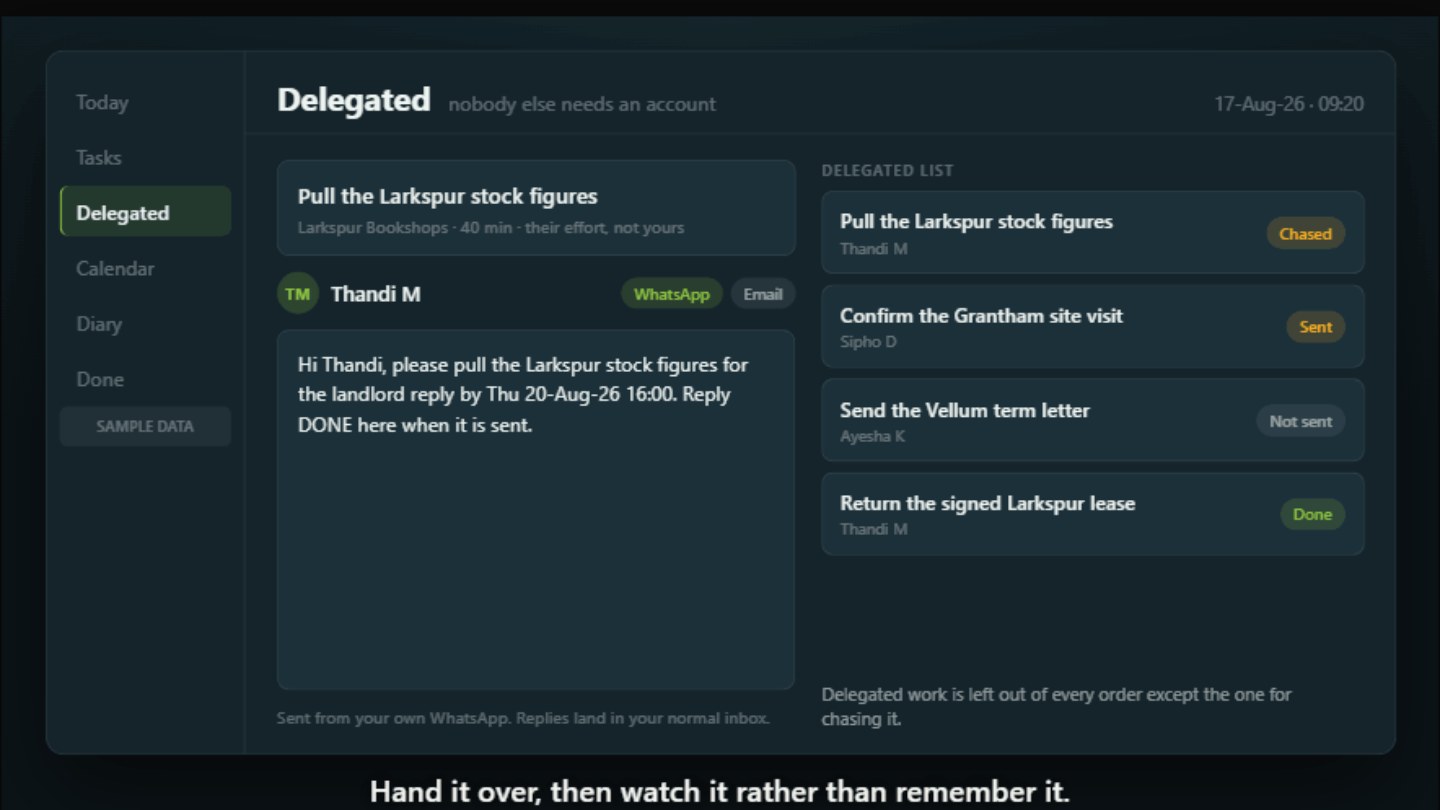
Assign a task to someone, send it from your own WhatsApp or your own email, and track it in a Delegated list until it comes back done.
Nobody else logs in. No seats, no invitations, no accounts for the people you delegate to. FocusMe writes the message, you press send, and their reply lands in your normal inbox. The delegate never knows FocusMe exists.
A request that arrives from a person gets acted on. One that arrives from a project-management system gets ignored.
The two seconds you spend pressing send are what make it a request from you. That's the design, not a shortcut.
The task, what "done" looks like, and why it matters
Exactly the context a delegate needs, and exactly what nobody ever bothers to type. So FocusMe asks for it.
A list of what you are owed, and who owes it
Not just what you own. Contacts are held on your device and encrypted like everything else, typed in for now.
Delegation is one-way: you send, they reply to you as a human. There's no status they update, no link they click, no portal. WhatsApp goes from your own number, by you pressing send, and it will stay that way. Outlook contact import is coming, not built.
What it gives back
FocusMe doesn't make you more disciplined. It removes the reasons you needed discipline in the first place.
Six things the mechanics hand back to you. None of them is a productivity claim.
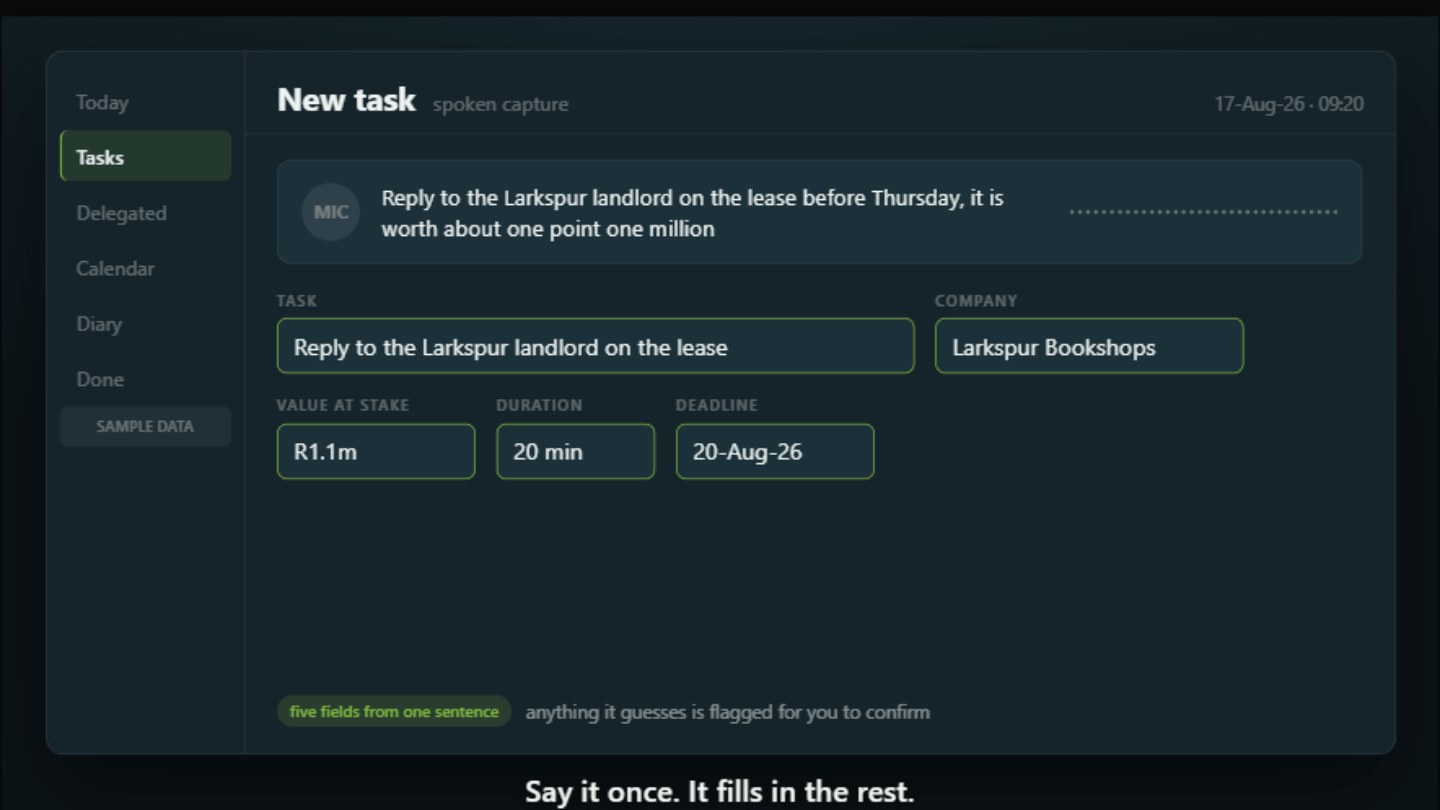
Say it out loud, the way you'd say it to a person
Describe the task in one sentence and the fields arrive filled in. Anything inferred carries a dotted underline, so you know exactly what to check. One sentence instead of eight fields is a real accommodation, not a shortcut.
You have never had evidence to the contrary. Now you do.
Thirty days of diary, alongside value delivered and value protected. If you have spent your life being called disorganised, this is the first record that argues back.
Over-committed by 1h 30m is an argument. Feeling stretched is not.
Capacity arithmetic turns declining from a confession into a fact. That is what makes saying no survivable.
Three seconds, one field, no decision required
Four buckets take it now and let you price it later. For anyone whose working memory is the bottleneck, that is the whole game.
The reason sits next to the task
Every tool you abandoned assumed you forgot. This one assumes you knew and could not begin, and puts the priced why where the pressure used to be.
Not forty times a day
Re-choosing what is next is its own tax. A stable ranking means you spend the day executing instead of re-deciding.
Two more, then the whole thing
Getting it in, and handing it out
The two parts people ask about most: how a task gets captured without typing five fields, and what happens after you give one away.
And the full tour, if you want all of it in one go
Forty-five seconds, running on a laptop and a phone, with sample figures throughout. Silent, captioned, and it will not play until you ask it to.
The other currency
Your day is arithmetic, not optimism
Your Outlook meetings come in read-only, from as many mailboxes as you have, each mapped to the company it belongs to. Once your tasks carry a duration too, they're on the same clock, and the Today view sums both against the hours you actually have.
Over-committed by 1h 30m. Something moves, or something slips.
Declined meetings and anything marked free are excluded, because neither is a real claim on your time.
Quick Wins
How much time have you actually got?
Value divided by duration gives value per hour, so the gap before your next meeting has a best possible use. Change the number and watch the order change.
Six open tasks. 4 of them fit in 20 minutes. This is the order.
Comparison
Everything else answers what. We answer why.
Outlook Tasks, Todoist, Planner and the rest are genuinely good at the job they were built for: remembering the item, showing the date, moving it along. If forgetting is your problem, use them, they'll serve you well. None of them holds the reason you'd start.
| Capability | FocusMe | Task lists | AI schedulers | Daily planners |
|---|---|---|---|---|
| Remembers the item | Yes | Yes | Yes | Yes |
| A duration on every task | Yes | Optional | Yes | Optional |
| Why it matters, as a structured field | Yes | No | No | No |
| What finishing is worth, in money or time | Yes | No | No | No |
| Urgency and importance, as a matrix | Eisenhower | No | No | Sometimes |
| A Rand figure, or an explicit "cannot be quantified" | Yes | No | No | No |
| Value per hour, where both are known | Yes | No | No | No |
| Benefit gained and loss avoided, reported apart | Yes | No | No | No |
| Meetings from several Microsoft 365 tenants | Yes | No | One account | No |
| What delay is costing | Yes | No | No | No |
| Ranked by value per hour | Yes | No | By fit | No |
| Never punishes a missed day | By design | Overdue badges | Reshuffles | Daily ritual |
FocusMe sits in the first column because it is the column the others are being measured against. Grouped by category rather than by product, because the differences within a category are smaller than the differences between them. Verified 14-Aug-26.
Backup and recovery · v1.19 and v1.20
Two files, because one file would be wrong.
Every hour, into a folder you pick once. Put it inside OneDrive and the copy leaves the machine without anything else changing.
focusme-data
Tasks, diary, companies, contacts. It holds no secrets, so it restores with no passphrase.
focusme-vault
The relay secret, the sync passphrase and your API key, under AES-GCM, keyed by PBKDF2-SHA256 at 600,000 iterations.
The split is the point. A backup that needs a passphrase before it will give your tasks back fails on the day the passphrase is lost, and a backup that hands your relay secret to whoever finds the file is worse than no backup at all.
Restoring is three steps: choose the file, see what is in it, confirm. It can be undone.
The recovery card
There is no password reset, and there cannot be one.
Your passphrases never leave your device, so nobody here is holding a copy that would let you back in. That is the correct design, and it has exactly one failure mode, which is forgetting.
So FocusMe prints you one page: both passphrases, the relay address and secret, and the four steps to rebuild from nothing. Print it, put it where you keep the things you cannot replace.
Privacy, stated precisely
Your data stays yours. Here's exactly what that means.
This is the strongest thing we can say about FocusMe, so it's worth saying it accurately rather than loudly.
Encrypted on your device, before it goes anywhere
Tasks and diary entries live on your devices and are encrypted with AES-GCM using a key derived from a passphrase that is never transmitted. The sync server stores ciphertext it cannot read.
The reminder service is never told what your tasks say
It receives a time and a generic label: "Task due", or "Meeting in 30 minutes". That's the whole payload.
Both are stated inside the app itself, not just here.
The relay proxies Microsoft Graph, so meeting subjects pass through it in transit. They are never stored.
Describing a task in a sentence sends that sentence to Anthropic directly from your browser, using your own API key, which you can revoke at any moment. That call does not pass through the relay.
Not "nothing ever leaves your device". Not "zero knowledge". Not "end-to-end encrypted" without saying what the ends are. The first two would be false, and the third invites a question we'd rather answer up front than dodge.
Delegation adds no new place where data is stored. Messages are composed on your device and handed to WhatsApp or your mail app to send. Nothing is queued, nothing waits on a server, and the reminder relay still never sees task content.
A "send later" feature was designed and then dropped, precisely because queueing a message would have meant storing its contents on a server. Most products quietly weaken their privacy claims as they add features. This one didn't.
The evidence
Why we built it this way
Four findings shaped the product. Each one is named, so you can go and read it yourself rather than take our word for it.
Make the end concrete and you weigh it differently
Imagining a specific future event measurably reduces how steeply people discount it against right now. It's why we make you describe the end, not just name the task.
Beating yourself up makes the next delay more likely
Procrastination is emotion regulation, not time management. That's the whole reason there are no red overdue badges and no streak you can lose.
If-then plans improve follow-through
Deciding in advance when and where you'll act has a large evidence base behind it. Later work qualifies the size of the effect, and we say so rather than quote the best number.
Unfinished work follows you into the next thing
Switching away from something you haven't finished carries a measurable cost into whatever you do next. Fewer, better-chosen starts beat more of them.
What the evidence doesn't support: any claim that FocusMe improves your completion rate, your wellbeing or your performance. The app is live and in daily use, but by one person, with no held-out measurement. When we have it, we'll publish it, including the parts that don't flatter us.
Under 18
Getting a parent's yes, without the nagging
Asking a parent for permission is friction, and friction at fifteen means you never come back. So we took the wait out of it: you start immediately, and the permission catches up with you.
Where the law sets a different age we apply whichever rule is stricter for where you are. Thirteen to sixteen across the EU under GDPR Article 8, under eighteen in South Africa under POPIA section 35.
Start using it before anyone says yes
Everything stays on your own device. No account, no email, no name, nothing sent anywhere. There's no personal data to protect yet, so there's nothing to consent to yet either. You get the whole thing, immediately.
One tap. We do the asking.
Type in a parent's number or email and we send them a short link. It explains what this is and what it collects, in plain language, with no signup pitch and nothing for them to install. You don't have to explain it, and you don't have to ask twice.
They see one screen and tap approve
One page: what's collected, what never is, and what they can do later. They approve, then confirm on a second channel so the consent is verifiable in the way both GDPR and POPIA require. No account for them, no app, no card.
Meanwhile you carry on working. When the yes arrives, what you've already done syncs across. Nothing was lost while you waited.
What we've committed to
Some of these cost us features
They're here because a tool that fixes your focus by making you feel worse isn't a tool worth building.
No streak held hostage
Miss a day and you haven't lost anything. That's not a motivator, it's a hostage situation.
No red overdue badges
A red number is a small dose of the disease. We describe consequences in the world, never scold you.
Nothing is deleted
The record of what you finished is the point. It only ever grows.
No surveillance layer
No manager dashboard, no behavioural reporting, no parent reading your task contents.
Reduced motion is honoured
Everywhere, including this website. If your system asks for stillness, you get stillness.
No trackers on this page
No analytics scripts, no pixels, no web fonts, no external requests. Check the source.
Your passphrase never leaves you
Which means we cannot read your data, and also cannot recover it for you. That trade is deliberate and it is stated plainly in the app.
Every claim gets its qualifier
Where the privacy story has an exception, the exception is on the page. A claim that needs small print isn't a claim worth making.
The task is not the end. It is a means to the end.
If the end is not visualised, and given meaningful value, there is no true reason to perform it. That's the whole argument. Everything above is just us taking it seriously.
Being straight with you: v1.16 is live and free to use, and it installs from the browser onto a phone or a laptop. Delegation is being built now and is one-way by design. There are no teams, no billing and no sharing, and the only integration is Microsoft 365 calendars. Describing a task in a sentence needs your own Anthropic API key and costs fractions of a cent.